Main sector D 19
Lucas Leffler presents his first solo exhibition in the main section of Paris Photo. On this occasion, previously unseen works from the projects REVO, Bleached Moment, and Implosion are unveiled.
This exhibition marks six years of collaboration with the Intervalle Gallery, which was the first to champion his work, and his fourth appearance at the fair alongside the gallery.
Trained at the Ilya Prigogine School of Advanced Studies and the Royal Academy of Fine Arts in Ghent, the artist explores the “alchemy of silver” in photography. His works are included in the collections of the Museum of Photography in Antwerp, the Musée de l’Élysée, the New York Public Library (to be acquired in 2026), as well as in numerous other major institutions and private collections.
From the industrial era (Kodak, Agfa) to the digital revolution (Apple), Lucas Leffler revisits the turning points in photography to reveal its technical, economic, and cultural implications. By reviving silver-based processes, he reminds us that photography remains a tangible medium: behind every image—even a digital one—lie individuals, factories, and industrial decisions.
Implosion
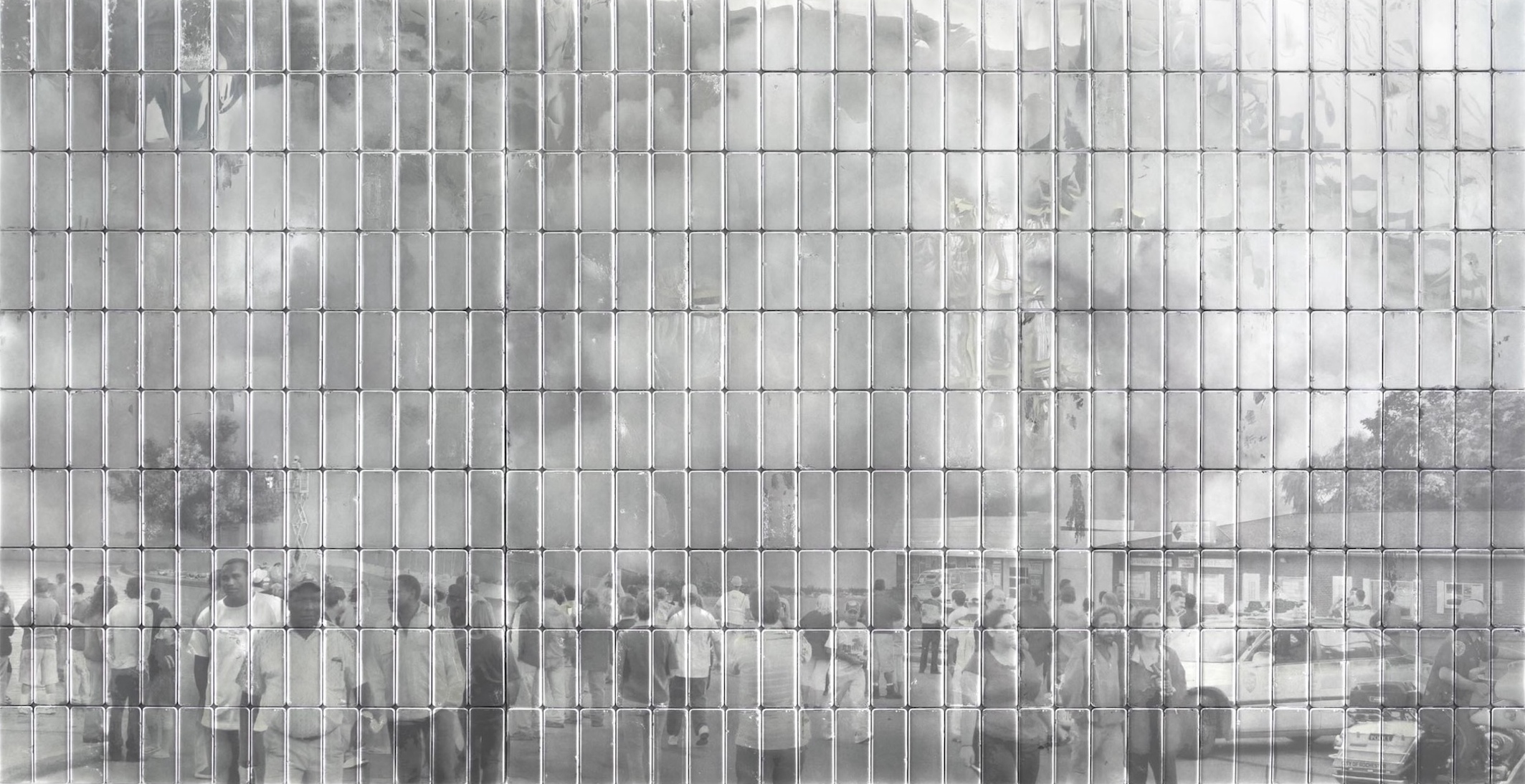
On June 29, 2007, the iPhone made its debut. The next day, the demolition of the Kodak factories in Rochester began, rewriting history: digital technology triumphed, while film photography collapsed.
These works reassemble, on a grid of iPhone screens or those of its successors, an image extracted from amateur videos of the implosions. In the darkroom, Lucas Leffler prints screen by screen using silver halide photography. A UV flash fixative seals the work.
A radical paradox: the iPhone becomes both a light-sensitive surface and a technological tomb. The digital preserves the trace of the analog. Kodak’s poetic revenge on Apple.
Revo
In 2000, Kodak proclaimed its digital transition with the slogan “What a nice day for a revolution!” In 2007, its historic factories were demolished by implosion. Workers filmed and posted these images of destruction online.
Nearly twenty years later, Lucas Leffler brings them back to life. He copies these archives and returns them to physical form, to a lasting trace. By choosing the wet collodion process—a technique dating back to the birth of photography in the 19th century—he acts like an alchemist, transforming ephemeral pixels into indelible prints. The destroyed factory comes back to life as a silvery ghost. Photography is reborn, not in spite of its foretold death, but because of it.
Bleached Moment
“Click-clack, thank you.” That’s how Kodak invited us in 1967 to freeze moments for eternity. But memory doesn’t work that way.
Drawing on unprecedented access to the Kodak collection at the Nicéphore Niépce Museum, Lucas Leffler explores color negatives: industrial images, factory views, and advertisements from the 1960s. He crops them, prints them as Kodak chromogenic prints, and then alters them. The colors soften, and certain textures take on a patina. Each modification makes the image unique, just as every memory is. Bleached Moment challenges our own reconstructions of the past, where imperfection becomes authenticity.


