Elena Chernyshova
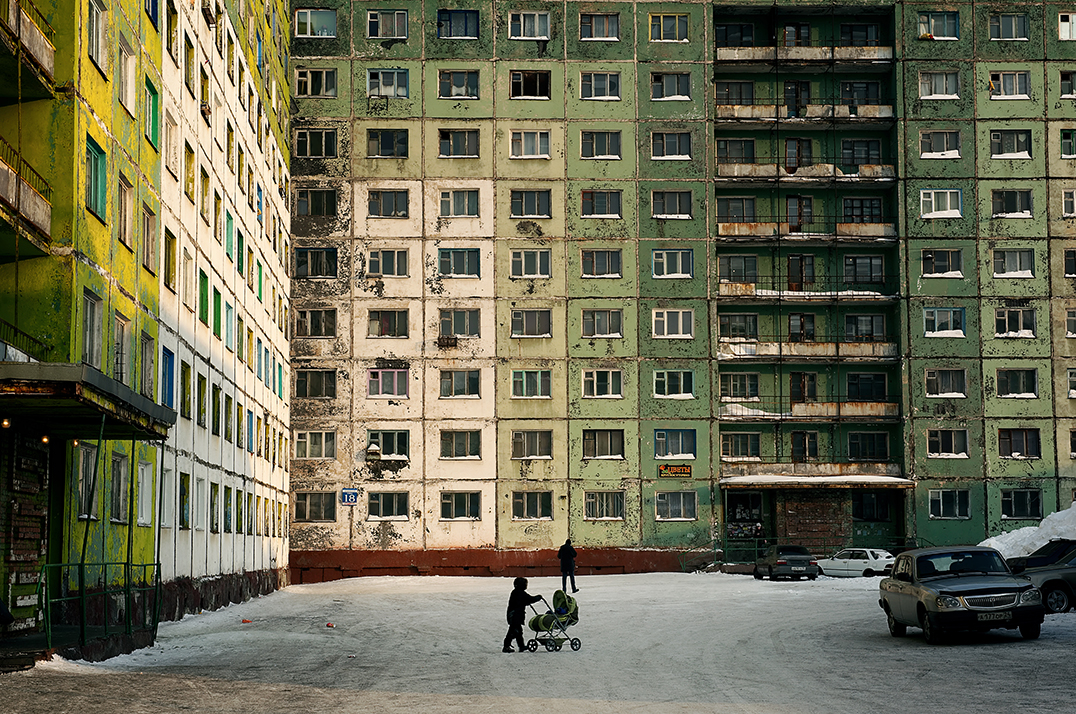
Produced from January 2012 to February 2013, “Jours de Nuit – Nuits de Jour” is a photo essay dedicated to the daily lives of the residents of Norilsk, a mining town located 400 kilometers north of the Arctic Circle in Siberia.
Born in Moscow in 1981, Elena Chernyshova is a Russian-French documentary photographer currently based in France. Self-taught, she discovered photography while studying architecture. After working as an architect for two years, she undertook a bicycle expedition from Toulouse to Vladivostok and back: 30,000 kilometers, 26 countries, and 1,004 days of travel. This experience was pivotal in her decision to become a photographer. Her work explores the daily lives of communities facing environmental, economic, and political transformations, as well as the ways in which they adapt.
In 2011, she received the Photographer Fellowship from the Jean-Luc Lagardère Foundation to produce “Jours de Nuit – Nuits de Jour.” The series was honored in 2014 with third prize at the World Press Photo in the “Daily Life – Stories” category and with the Days Japan International Photojournalism Award. It was also published in National Geographic in January 2014.
With a population of over 170,000, Norilsk is one of the major cities in the Russian Arctic. Built beginning in the 1930s as an industrial city, it developed around the mining and processing of nickel, copper, palladium, and other metals. Its history is inextricably linked to that of the Soviet Gulag: mines, factories, and infrastructure were built primarily by prisoners from the Norillag camp.
Living conditions in Norilsk are particularly harsh. The average annual temperature is around –10 °C and can drop as low as –55 °C in winter. The city experiences long periods of snow, and during the polar night, the sun does not rise for several weeks.
But rather than painting a picture of a hostile landscape, Elena Chernyshova focuses on showing how its inhabitants have learned to live there. Through the changing seasons, work hours, leisure activities, and moments of family life, her photographs reveal the ways people have adapted to the cold, isolation, and the consequences of industrial activity. The title of the series thus reverses the usual notions of day and night and captures the unique experience of a city where the rhythms of life are profoundly shaped by the extreme conditions of its environment.


